
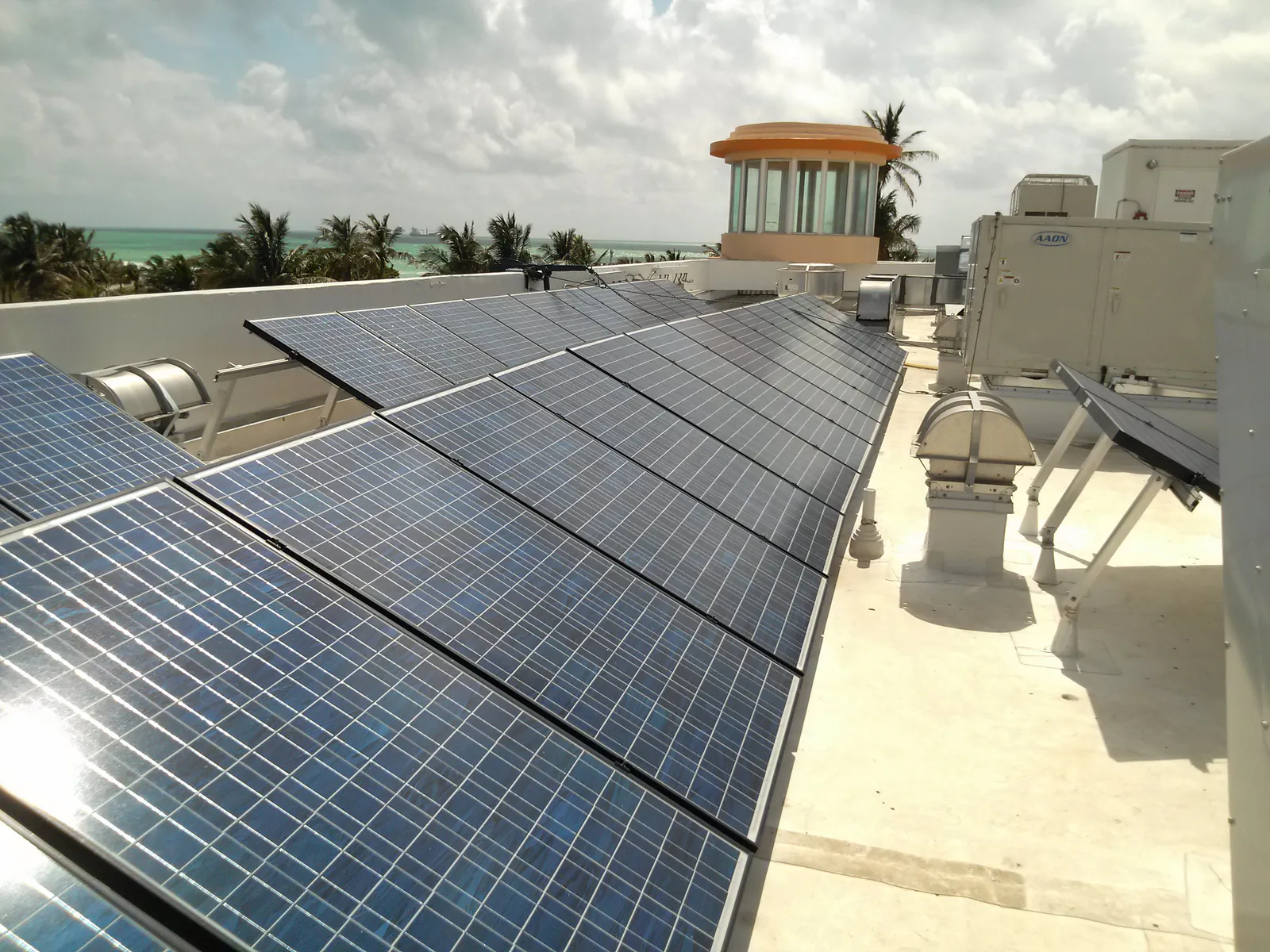
If it looks like your solar panels are not working in the heat, check the calendar first. Hot panels make less power, and in a national lab’s model of a Tampa roof, July comes in 17% below May.
Most of that gap is not heat. The model puts 16% less sunlight on the panels in July than in May, and you can check your own system from the ground with your monitoring app.
Why solar panels make less power in the heat
Panels get their power rating in a lab with the cells at 25 degrees Celsius, which is 77 degrees Fahrenheit. Past that point, the lab model behind the PVWatts calculator has output fall in a straight line as the cells warm. Aron P. Dobos wrote its manual in September 2014 for the National Renewable Energy Laboratory, now called the National Laboratory of the Rockies.
The rate of that drop is called the temperature coefficient. It is printed on the datasheet for your panels as the “temperature coefficient of Pmax” or “PMPP.”
A Qcells datasheet from February 2026, for its Q.TRON BLK M-G2+ panels, lists a drop of 0.29% for each degree Celsius.
Older panels tend to give up more. The lab’s 2014 manual assumed 0.47% for a standard panel, and its calculator now assumes 0.37%. The manual said the lower values “indicate improved performance of newer modules.”
How hot panels get on a Tampa Bay roof
The cells run hotter than the air. Sunlight on the panel, air temperature and wind speed set their temperature, and so does the way the panel is mounted, according to Sandia National Laboratories’ module temperature model.
Air moves less freely behind roof panels than behind panels on an open rack. The PVWatts manual estimates roof-mounted cells at roughly 49 C, or 120 F, in its reference sunlight when the air is only 68 F.
At that cell temperature, a panel with the calculator’s 0.37% coefficient makes about 9% less power than it would at the test temperature. The Qcells panel would make about 7% less. Both figures are our arithmetic from the lab’s numbers, not measurements from a roof.
Tampa’s normal high in July is 91 F, the National Weather Service’s 1991-2020 normals show. That is 14 degrees above the test temperature before the sun has warmed the glass at all.
What a normal July looks like in Tampa
We ran PVWatts, the lab’s free calculator, on Nov. 12, 2026 for a Tampa roof that faces due south at a 20-degree tilt.
For each kilowatt of standard panels, its typical year gives 152 kilowatt-hours in May, 126 in July and 109 in December. March, April and May are the three best months.
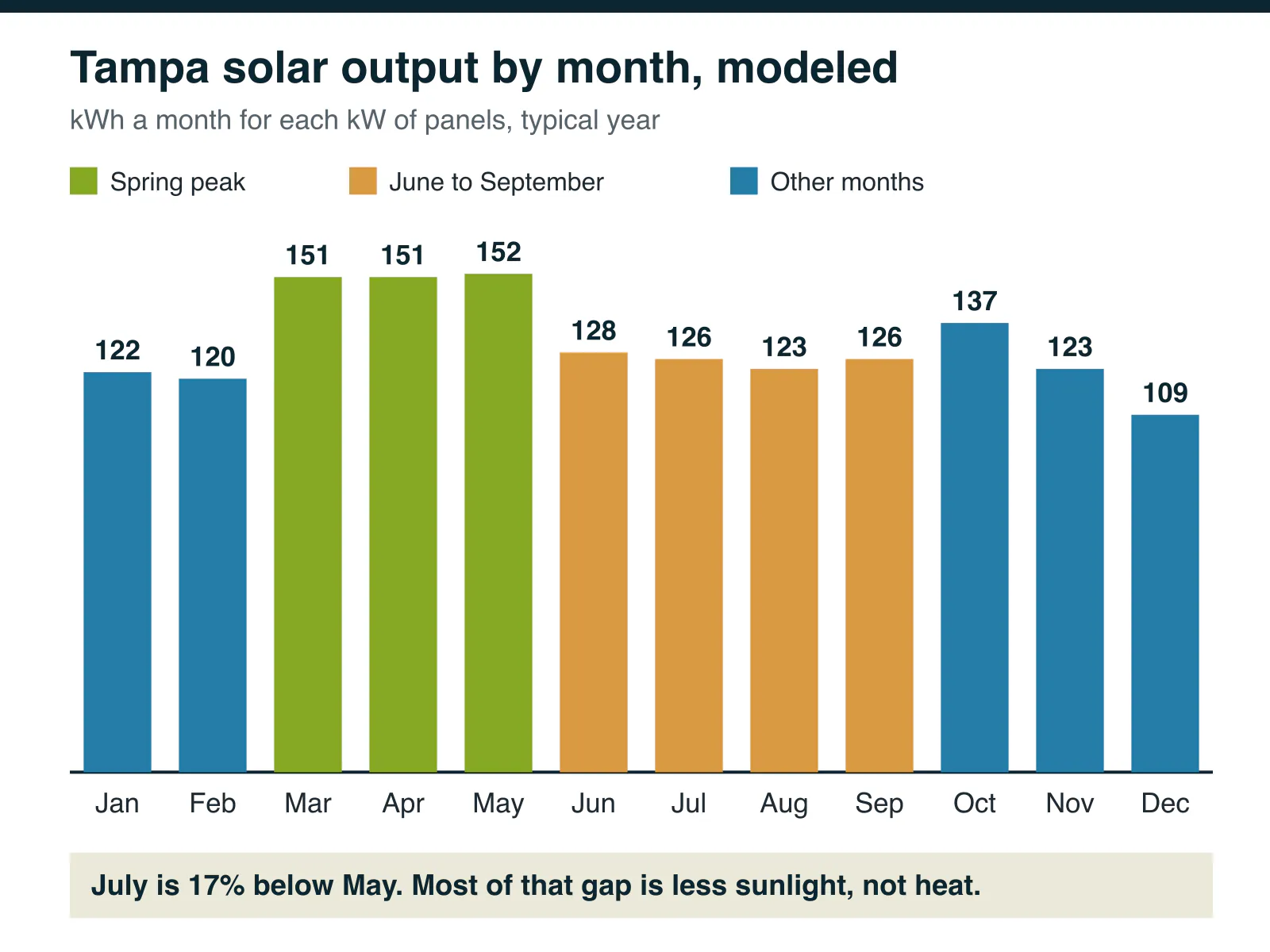
Heat explains little of the drop from May to July, because May is already hot. For each unit of sunlight that reaches the panels, the modeled array makes about 1% less power in July than in May.
The rest is sunlight that never arrives. July is deep in the wet season, with a normal 7.75 inches of rain at Tampa, the weather service’s table shows.
Heat shows up when you compare summer with winter. For each unit of sunlight, the modeled array makes about 8% less power in July than in January.
The model describes one roof in a typical year. Your tilt, the direction the roof faces, shade and equipment will move the numbers.
Solar panels not working in the heat, or a real problem
Compare July with last July, not with April. Our care guide says to compare this month’s production with the same month last year, and to treat a drop with no obvious reason as a sign.
Look from the ground, never the roof. A dusty or yellow film, bird droppings, leaves, or a line of dirt along the lower edge of the panels all block light, and none of it is heat.
A system that reads zero or shows offline has a different problem. That is a maintenance call. Any electrical fix, inverter and microinverter swaps included, is done by Union Grid Solar, Florida Certified Electrical Contractor EC13015579.
Heat warms the whole array. A thermal inspection uses a handheld infrared scan to look for unusual temperature patterns across the panels. It is non-invasive, it is not an electrical diagnosis, and thermal images do not reveal every type of fault.
What to do about a summer drop
If this July matches last July, the system is likely doing what the model expects, and the same-month check works in any season.
If the numbers do not match, send a maintenance request or ask about a thermal inspection. If you can see a film from the yard, our article on whether rain cleans solar panels covers what stays on the glass.
SAM, our ongoing care program, pairs regular cleanings with thermal inspections for as long as your panels are on the roof. We work in Tampa and across Hillsborough and Pinellas counties.
Sources
- National Laboratory of the Rockies (formerly NREL): PVWatts Version 5 Manual, Aron P. Dobos (September 2014)
- National Laboratory of the Rockies: PVWatts model notes in the System Advisor Model help
- National Laboratory of the Rockies: PVWatts Calculator (Tampa run of Nov. 12, 2026)
- Sandia National Laboratories: Sandia Module Temperature Model
- National Weather Service Tampa Bay: Tampa July normals (1991-2020) and records
- Qcells: Q.TRON BLK M-G2+ series datasheet (February 2026)
Sources reviewed Nov. 12, 2026.