
Rain washed some pollen off the solar panels in a study led by the National Renewable Energy Laboratory, but it did not clean them back to the output they had before. The researchers tracked five utility-scale solar plants in four North Carolina counties, not homes in Florida.
Two of the trees behind that pollen, pine and oak, also top Florida’s list. UF/IFAS Extension agents put the state’s pollen season at January to June, and you can judge whether your own panels need a wash from the yard and your monitoring app.
How well rain cleans solar panels
The researchers expected small losses because the region gets a lot of rain with short dry spells in between, according to NREL’s Dec. 18, 2023 release on the study.
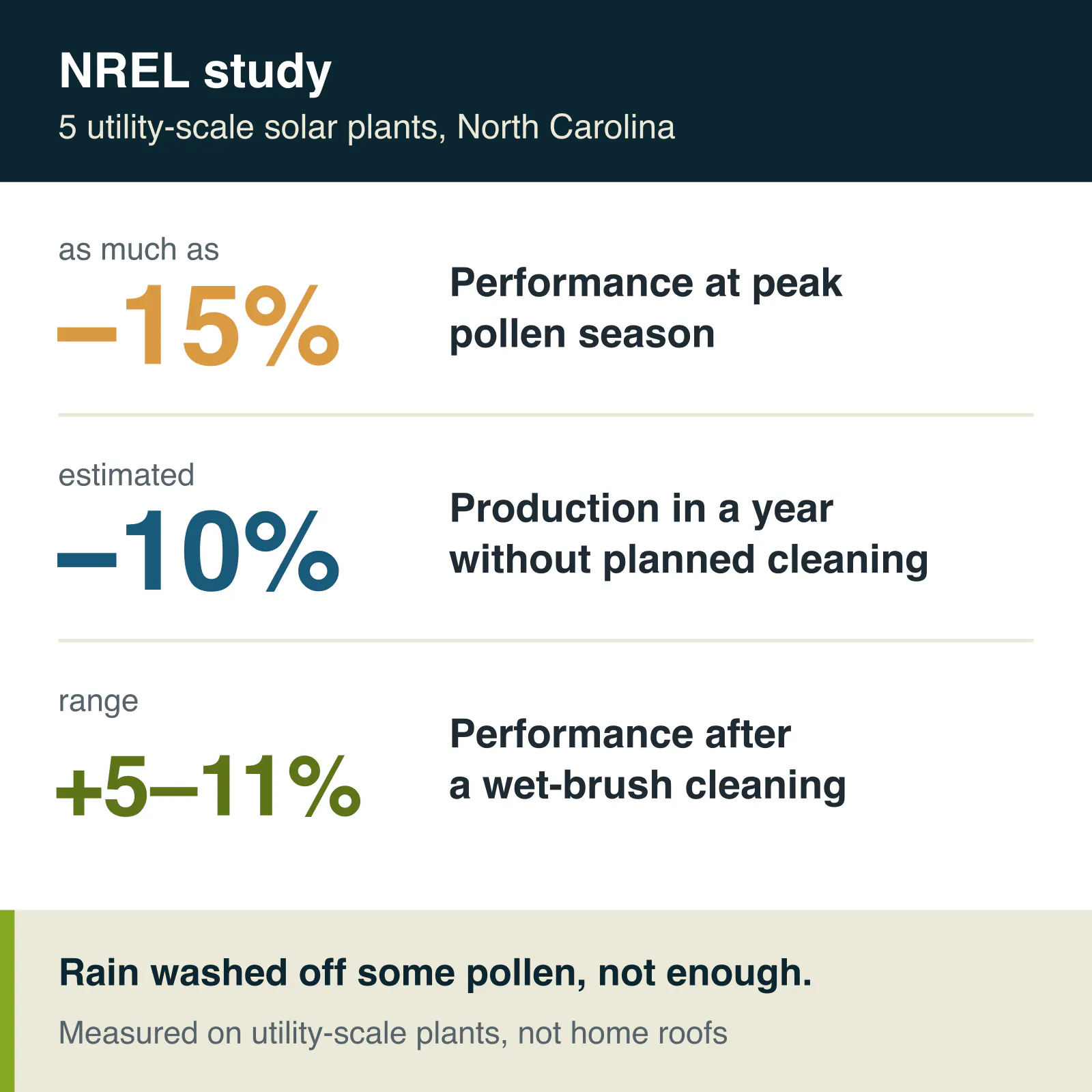
Instead, spring pollen lowered performance at every site, by as much as 15% during peak pollen season. Most of it came from cypress, juniper, pine and oak trees.
Rain did wash some of it away. Even after the pollen season ended, the panels did not get back to their earlier “cleaned” levels despite frequent rains, the release said.
The plants had run for more than seven years without a manual cleaning. NREL said that without planned cleaning, annual production losses can be on the order of 10%, based on the data.
Solar Unsoiled, whose co-founder Michael Valerino co-wrote the paper, measured performance gains of 5% to 11% after a mechanical wet-brush cleaning.
Matthew Muller, an NREL research engineer and a co-author, said “regular rainfall is not sufficient to assume that solar plants are fully cleaned in certain environments.” The paper ran in the IEEE Journal of Photovoltaics.
What the study did not measure
None of the data came from a home roof or from Florida. The five sites were utility plants of 4 to 9 megawatts, with panels facing due south at a 20-degree tilt, pv magazine reported. The percentages describe those plants, not your system.
The lab has a new name, too. The U.S. Department of Energy renamed NREL the National Laboratory of the Rockies on Dec. 1, 2025.
In 2023, NREL said it was designing a follow-up study with Solar Unsoiled on pollen and other biological soiling in the Southeast. A search on Nov. 9, 2026 found no published results from it.
Others are more relaxed about rain. Maxeon, a solar panel maker, tells owners that “seasonal rains are usually enough to adequately clear any soil or dust that might accumulate.”
Jason Szumlanski of Florida Solar Design Group argued in February that paid cleaning rarely pays off on typical Southwest Florida homes. His exceptions include heavy bird droppings and very low-tilt arrays.
Pollen season in Tampa Bay
Florida’s pollen season runs from January to June, according to UF/IFAS Extension agents in Hillsborough and Manatee counties. In 2024 they named oak, pine and palm as the major culprits.
Pollen is light and dry and can travel up to several miles on the wind, they said. Panels can collect it even with no tree hanging over the roof.
Pollen is not the only thing that stays on the glass. Our care guide lists bird droppings, salt film near the coast and Saharan dust in summer among what lands on Tampa Bay panels. Rain washes some of it away, but sticky residue stays behind.
How to tell if your panels need cleaning
Start on the ground. Maxeon says owners should not go onto the roof to clean or inspect panels and should call a professional instead.
From the yard, look for a dusty or yellow film, bird droppings, leaves, or a line of dirt along the lower edge of the panels.
If your system has a monitoring app, compare this month’s production with the same month last year. A drop with no obvious reason is a sign. Florida Solar Design Group counts a drop that lasts through rain as a case where cleaning can make sense.
A system that reads zero or shows offline has a different problem. That is a maintenance call, not a cleaning. Any electrical fix, inverter and microinverter swaps included, is done by Union Grid Solar, Florida Certified Electrical Contractor EC13015579.
Skip the hose and the pressure washer. Hard tap water leaves mineral spots, and stiff brushes or harsh cleaners can scratch the glass and its coating, so follow your panel maker’s care instructions first.
How often to clean solar panels
No single schedule fits every roof. NREL’s release said “planned cleaning may be necessary to avoid large financial losses and system underperformance” in rainy regions, at least for plants like the ones it studied. Maxeon says seasonal rain usually handles soil and dust.
On your roof, the answer turns on the trees nearby and on what your monitoring numbers show over a year.
KleenSola owner Alex Ashekun describes SAM, our ongoing care program, as a visit every six months, with cleanings and thermal inspections on a schedule for the life of the system. We clean with soft brushes and deionized water, which dries without mineral spots.
We note production before a cleaning and go over it with you in your monitoring app a week to ten days later, without promising a set percentage.
If pollen season left a film you can see from the yard, start with a one-time solar panel cleaning. To keep cleanings coming for as long as the panels are on the roof, look at SAM. We work in Tampa and other communities in Hillsborough and Pinellas counties, and more answers are on our questions page.
Sources
- NREL (now the National Laboratory of the Rockies): NREL Research Finds Rain Not Enough To Wash Pollen From Solar Panels (Dec. 18, 2023)
- Bessa et al.: An Investigation on the Pollen-Induced Soiling Losses in Utility-Scale PV Plants, IEEE Journal of Photovoltaics (2024)
- pv magazine: Rain does not remove pollen from PV panels, say researchers (Jan. 10, 2024)
- U.S. Department of Energy: Energy Department Renames NREL “National Lab of the Rockies” (Dec. 1, 2025)
- UF/IFAS: Answers from UF/IFAS experts as pollen blankets your car and makes you sneeze (March 13, 2024)
- Maxeon: Should I clean my solar panels?
- Florida Solar Design Group: Solar Panel Cleaning Is Usually a Scam (Here’s the Math) (Feb. 20, 2026)
Sources reviewed Nov. 9, 2026.