
If your solar company went out of business, your panels keep working. The warranties from the companies that made your equipment usually stay in force. The installer’s own warranty on the work is the part that usually goes with it.
That split decides who you call next. Here is what to look up from your own paperwork, with the warranty, license and permit details as of Nov. 16, 2026.
What survives when a solar company goes out of business
A home solar system comes with two kinds of warranty, according to a guide Solar United Neighbors published on March 4, 2025.
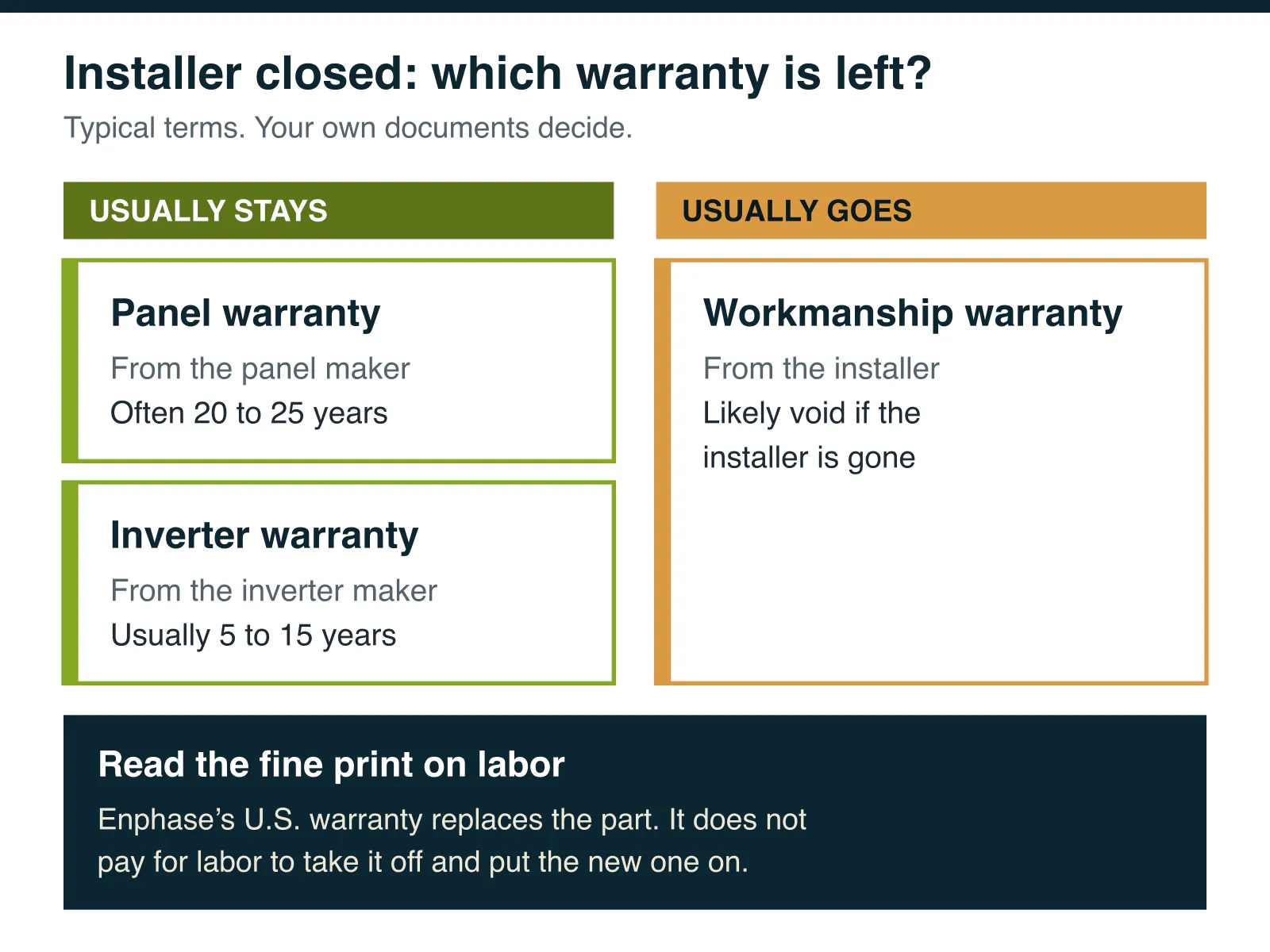
Manufacturer warranties cover the panels and inverters. The equipment makers usually provide them, not the installer. Panel warranties often last 20 to 25 years and inverter warranties usually last five to 15 years, the guide says.
The workmanship warranty covers the quality of the installation. If the installer is out of business, that warranty is likely void, the guide says, and you will need a new installer for any problem with the work.
EnergySage says the same about equipment. Maker warranties remain valid whatever the installer’s status, according to its guide by Alix Langone and Jacob Marsh, updated Jan. 7, 2026.
The guide has a caution too. If both the installer and the maker end up bankrupt, you could lose warranty protection.
What a manufacturer warranty leaves out
A maker’s warranty can replace the part without paying anyone to put it on your roof.
Take the Enphase warranty for U.S. systems activated on or after Nov. 15, 2026. It covers IQ7, IQ8 and IQ9 microinverters for 25 years from activation. The IQ Gateway, the box that reports to the app, gets five years.
The same document says it does not include the cost of labor to take a covered product off, to put a replacement on or to troubleshoot the home’s wiring. Claims must reach Enphase within 90 days of finding the defect.
Older systems fall under earlier versions, which Enphase lists by activation date on its warranty page. Read the one that matches your system. Read your panel maker’s document the same way.
Swapping a failed part is licensed electrical work. When a request comes to KleenSola, inverter and microinverter swaps are done by Union Grid Solar, Florida Certified Electrical Contractor EC13015579.
Find your paperwork before you need it
Solar United Neighbors says to gather the system design, the installation contract, the warranties, and copies of permits and inspection reports.
Look in those papers for the brand and model of your panels and inverters. You need both names to reach the right maker. Do not climb on the roof to read a label.
Get your monitoring login back
If the installer gave you an app or web portal, get the login, the Solar United Neighbors guide says. Check who manages the monitoring too. It may be the installer or a third-party platform.
The Enphase warranty gives a second reason to keep the system online. It says covered products should stay connected to the internet during the warranty period so that defects can be found remotely.
A house bought with panels already on it is a separate case. Under the Enphase document, a later owner stays covered only after sending Enphase a change of ownership form and paying a transfer fee within 30 days of the transfer.
Look up the license and the permit in Florida
Two public records show who installed your system and what the county approved.
The Florida Department of Business and Professional Regulation runs a license search. You can search by name, license number, city or county, or license type.
Hillsborough County keeps building permit records from Jan. 20, 2021 to the present in HillsGovHub. Records from 2005 to Jan. 19, 2021 are on its Building Permits Reports page. Those from 1976 to 2004 are not online and take a records request, and the county’s search guide applies only to parcels in unincorporated Hillsborough.
In Pinellas County, the Access Portal can be searched by address without an account. The county’s permitting office serves unincorporated areas plus Belleair Beach, Belleair Shore, Indian Rocks Beach, Kenneth City, Safety Harbor and Oldsmar.
Who looks after the system now
Pick a company with experience working on your type of equipment, Solar United Neighbors says. Enphase’s installer locator lists certified installers by ZIP code, and Enphase notes that they are independent service providers.
KleenSola looks after systems that are already on the roof in Hillsborough and Pinellas counties. Our inspections are non-invasive, which means we observe and report.
If the system is offline or a part has failed, send a maintenance request. Maintenance is quoted on its own, and work that needs a Florida electrical license is completed with our partner Union Grid Solar.
If the system is running, SAM is our ongoing care program. It pairs cleanings and thermal inspections with a service history kept for the life of the system, so the record of visits, findings and repairs stays in one place.
Sources
- Solar United Neighbors: What to Do if Your Solar Installer Goes Out of Business (March 4, 2025)
- EnergySage: What do I do if my solar installer goes out of business? (updated Jan. 7, 2026)
- Enphase Energy: Limited Warranty, U.S., systems activated on or after Nov. 15, 2026
- Enphase Energy: U.S. warranties by activation date
- Florida Department of Business and Professional Regulation: License Search
- Hillsborough County: Building Permitting Records Search
- Pinellas County: Searching for a Record without an Account in Access Portal
- Pinellas County: Permitting Guide
Sources reviewed Nov. 16, 2026.